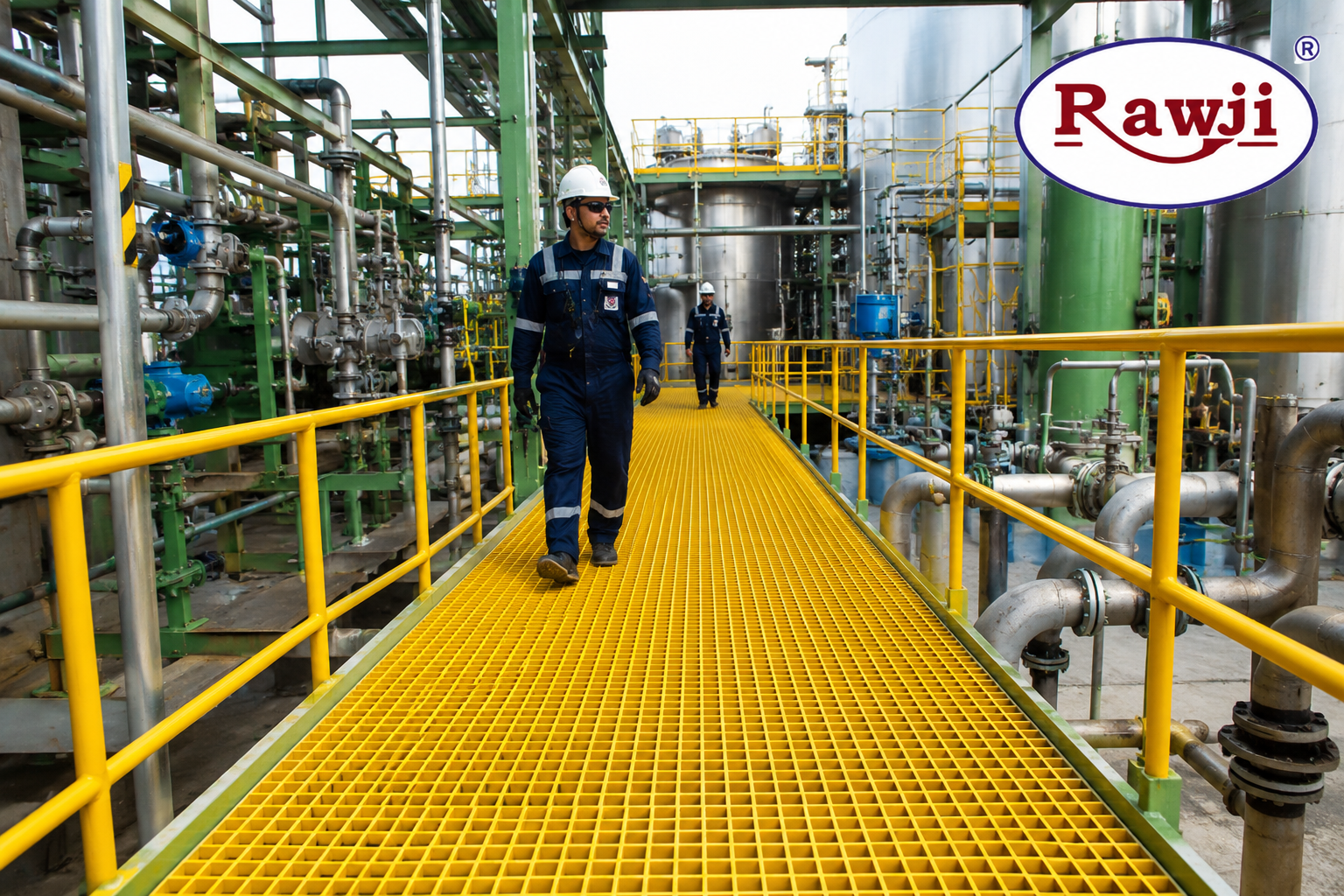
Choosing FRP grating by price alone is how walkways end up bouncy and trench covers end up cracked. The correct order of decisions is: mesh size for the application, then load capacity for the span, then resin for the environment — and price last, because the right panel is usually cheaper over its life than the cheapest panel. This guide gives you the selection chart engineers use.
Step 1: Pick the mesh size for the job
| Mesh | Best for | Notes |
|---|---|---|
| 12/25 mm mini-mesh | Offshore, public footbridges, food plants | Heel-proof — nothing drops through |
| 30x30 mm | Pedestrian walkways, ETP access, maintenance floors | Lightest panels, smallest bars |
| 38x38 mm | The industrial default: chemical plants, plating shops, effluent trenches | Best chemical-resistance per rupee |
| 50x50 mm | Heavy drainage, carriage-way medians, high-flow gullies | Maximum open area for water |
Step 2: Match load to span — the honest chart
Deflection is what people feel as "unsafe" long before a panel breaks. As practical guidance for 38x38 mm molded grating with UDL (uniformly distributed load) at a deflection limit engineers accept for platforms (roughly 6 mm): a 3.5-4 mm thick panel spans ~900 mm at 1.5 kN/m², ~600 mm at 5 kN/m²; a 6.5 mm panel spans ~1,300 mm at 1.5 kN/m² and ~900 mm at 5 kN/m². Pultruded I-4000/I-5000 panels stretch these spans further — which is why pultruded gratings own long clear spans on cooling towers and rail platforms. Always confirm the certified load table for your exact panel — our engineering team issues span charts per batch.
Step 3: Resin decides the lifespan, not the mesh
- Orthophthalic: dry general-industrial interiors. Cheapest — and the wrong choice near any chemical.
- Isophthalic: the outdoor default — humidity, washdown, coastal air.
- Vinyl ester: continuous acid, chloride and solvent exposure — ETPs, plating, chlorine rooms. The upgrade costs a fraction of replacing a corroded walkway; see our chemical-resistant walkway gratings.
What molded vs pultruded means for your load chart
Molded panels carry load in both directions — ideal when you cannot control which way the support steel runs. Pultruded panels are stronger along the load bars and stiffer for their weight, ideal when spans are known and long. If your platform design is still open, read the molded vs pultruded comparison before the structure is drawn — the grating choice changes the steel.
Accessories that keep the chart honest
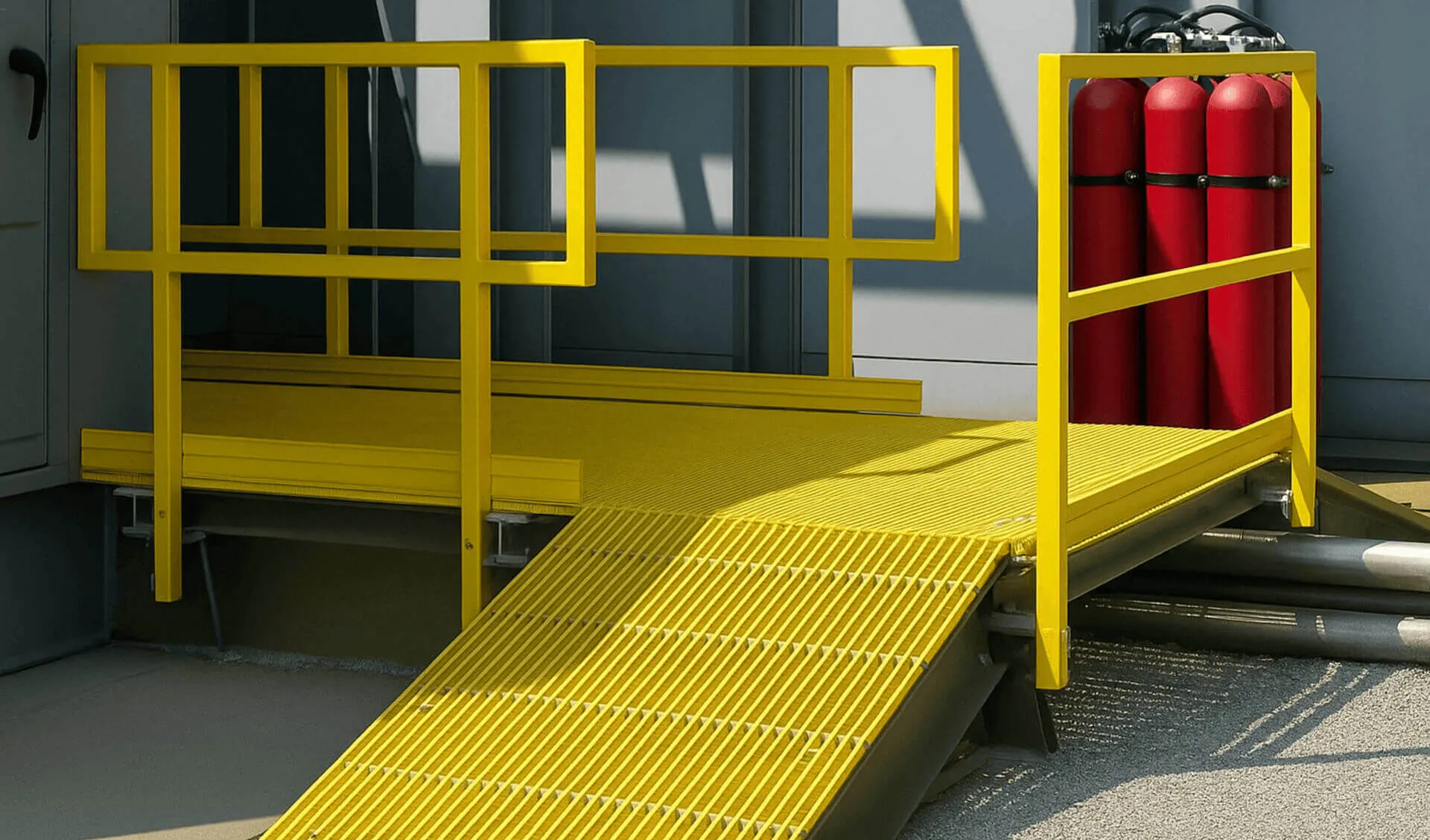
Load ratings assume panels are clamped, not loose-laid. Panels rattle, walk and crack at unclamped edges long before their load limit. Spec the full fixing set — M-clips, C-clamps and hold-downs in SS 316 — with every order, plus stair treads fabricated in-house.
Buying checklist
- Mesh size + bar thickness + panel thickness in writing (e.g. 38x38, 6.5 mm).
- Span and load per area from your drawing — we return the certified chart.
- Resin named: ISO / vinyl ester / fire-retardant grade.
- Anti-slip finish: meniscus or bonded grit.
- Cutouts, treads, clips quoted together — see grating pricing by mesh and resin.
Conclusion
Mesh for the application, span for the load, resin for the air — in that order. Rawji Exports moulds and pultrudes gratings in Bhiwandi and returns a batch-certified load chart with every quotation. Send the drawing; get the chart.