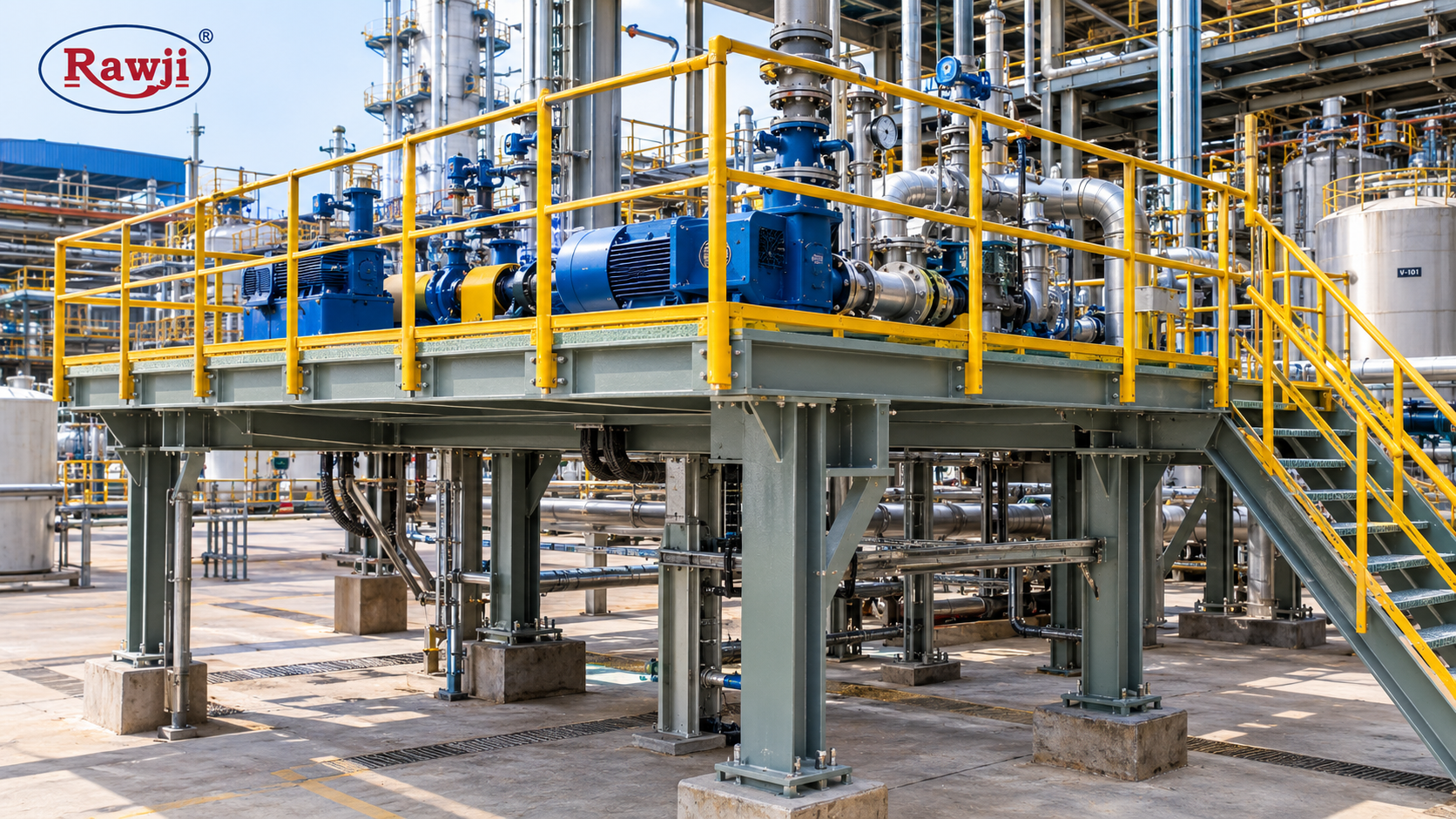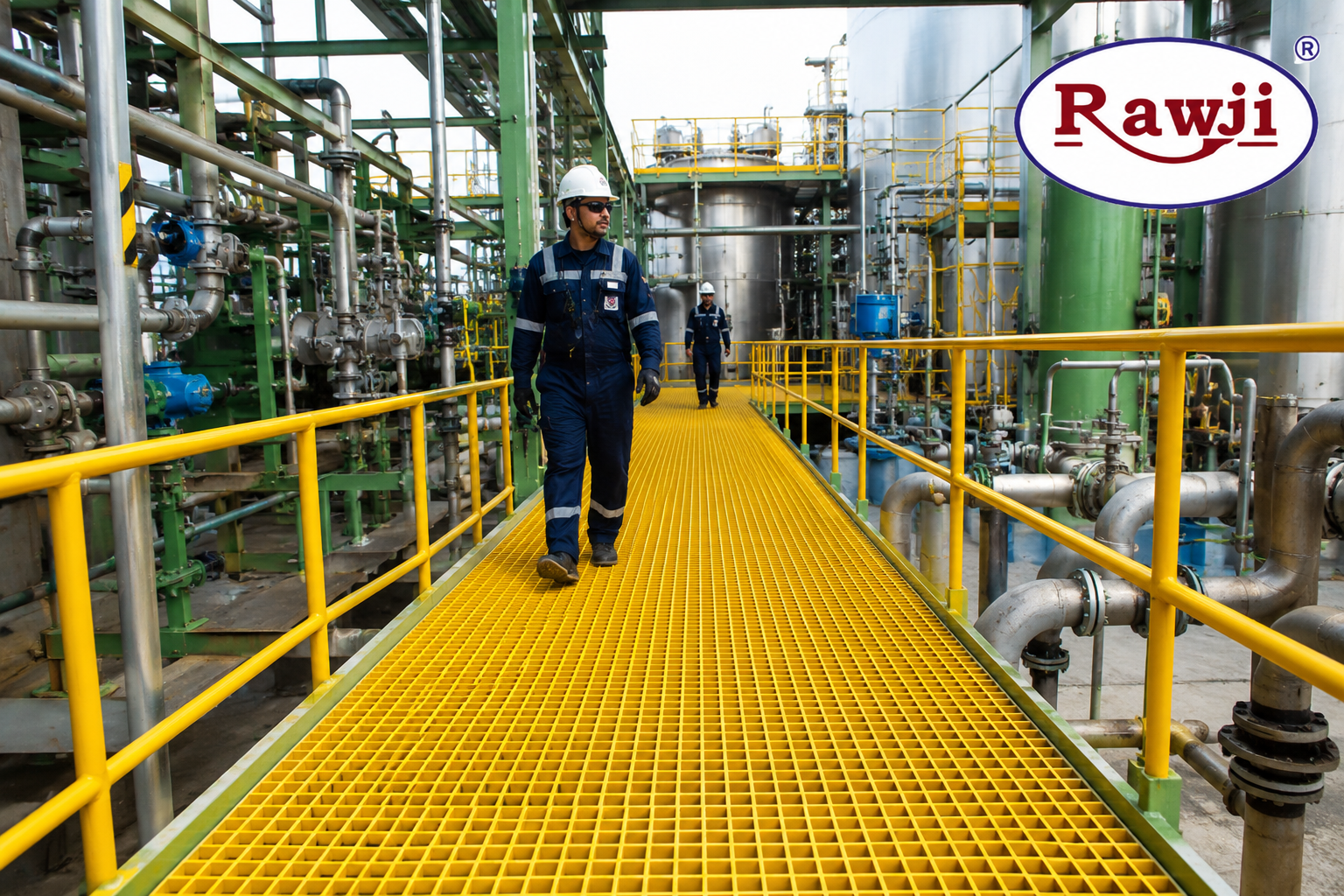

In chemical plants, refineries, wastewater treatment facilities and other industrial environments, a walkway is more than a floor placed above ground level.
Workers may be walking over areas exposed to water, oil, chemicals, humidity and process residues. The platform may also need to support maintenance activity, tools and equipment while providing safe access to valves, tanks, pumps and machinery.
This is where FRP walkways and catwalks can become useful.
Fiberglass-reinforced plastic systems can provide corrosion resistance, relatively low weight and slip-resistant walking surfaces for industrial applications. But simply choosing an FRP grating does not automatically make an entire walkway "OSHA compliant."
The complete installation—including the walking surface, support structure, access, guardrails, fall protection and maintenance—needs to be considered against the requirements applicable to the workplace.
OSHA's General Industry Walking-Working Surfaces requirements are contained in 29 CFR 1910 Subpart D, which addresses walking-working surfaces, ladders, stairs, fall protection and related requirements.
So what should an engineer or procurement team actually check before specifying an FRP walkway?
1. Start With the Actual Working Environment
The first question should not be:
"Which FRP grating is cheapest?"
It should be:
"What will this walkway be exposed to?"
An industrial walkway may be installed in:
- Chemical processing plants
- Refineries
- Wastewater treatment plants
- ETP and STP facilities
- Power plants
- Manufacturing plants
- Pulp and paper facilities
- Mining facilities
- Offshore and marine environments
- Utility areas
- Industrial rooftops
The environment affects the material specification.
For example, a walkway exposed to aggressive chemicals may require a different resin system from one installed inside a relatively dry manufacturing area.
Temperature, chemical concentration, moisture, UV exposure and cleaning procedures should all be considered before finalizing the FRP system.
2. Why FRP Is Used for Industrial Walkways
Traditional steel platforms can require ongoing maintenance in corrosive environments.
Once corrosion begins, maintenance teams may have to deal with:
- Rust
- Coating failure
- Surface deterioration
- Frequent repainting
- Reduced service life
- Difficult maintenance access
FRP can offer a different material approach.
A properly specified composite walkway can provide:
Corrosion resistance
Useful in environments where moisture and chemicals are present.
Low maintenance
FRP does not rust like conventional carbon steel.
Slip-resistant surfaces
Suitable surface systems can provide additional traction.
Electrical non-conductivity
FRP can be useful in applications where electrical insulation is an important design consideration, subject to the specific product and application requirements.
Lower handling weight
FRP components can be easier to handle than comparable steel components in many installations.
These characteristics explain why FRP gratings are used in industrial access platforms and walkways.
3. Anti-Slip Performance Matters
A walkway can be structurally strong and still create a safety problem if its walking surface becomes slippery.
Industrial platforms may encounter:
- Water
- Oil
- Chemicals
- Condensation
- Process liquids
- Mud
- Dust
- Cleaning fluids
OSHA's walking-working-surface requirements address hazardous surface conditions and require employers to maintain walking-working surfaces appropriately.
For this reason, buyers should specifically ask about the surface finish of the FRP grating.
Common industrial FRP grating configurations can incorporate abrasive grit into the walking surface to increase traction.
But do not rely only on the words "anti-slip."
Ask the supplier:
- What type of surface is provided?
- What test information is available?
- Is the surface suitable for wet conditions?
- Is it suitable for the chemicals used at the facility?
- How does the surface perform under expected contamination?
The application determines the appropriate specification.
4. Load Rating Is Just as Important as Slip Resistance
Another common procurement mistake is selecting FRP grating based only on thickness.
A walkway must be designed around its actual span and loading conditions.
The supplier or engineer should consider:
- Grating thickness
- Bearing bar dimensions
- Panel size
- Support spacing
- Span
- Pedestrian loading
- Maintenance loads
- Concentrated loads
- Equipment access
- Deflection requirements
For example, a walkway intended only for routine pedestrian access may have different requirements from a platform where maintenance personnel regularly carry tools or equipment.
Therefore, when requesting an FRP grating quotation, provide the supplier with the support span and expected loading, rather than asking only for a "heavy-duty FRP grating."
5. Guardrails Are Part of the Safety System
A catwalk is not just the grating.
If workers are exposed to a fall hazard, the surrounding fall-protection system becomes an important part of the design.
OSHA's 29 CFR 1910.28 addresses fall protection for employees on walking-working surfaces, including situations where employees are exposed to falls of 4 feet or more to a lower level in general industry.
OSHA's guardrail criteria in 1910.29 also specify performance requirements for guardrail systems, including strength and height-related requirements.
This means a project specification should consider:
- Top rails
- Midrails
- Posts
- Toeboards where required
- Access gates
- Stairways
- Platform openings
- Handrail configuration
- Fall-protection requirements
The exact design should be checked against the applicable OSHA requirements and other project standards.
6. Don't Treat "OSHA Compliant" as a Product Specification
This distinction is particularly important for procurement teams.
An FRP grating itself is not automatically "OSHA compliant" simply because it is made from FRP.
OSHA requirements generally concern the workplace and the installed walking-working surface/fall-protection system, not merely the material category.
For example, an FRP grating could have excellent slip resistance but still be unsuitable if:
- Its span exceeds its rated capacity
- Supports are incorrectly spaced
- Openings are inadequately protected
- Guardrails are missing where required
- The installation creates a trip hazard
- The surrounding access system is unsafe
Therefore, a better procurement question is:
"Can this FRP walkway system be specified and installed to meet the applicable OSHA requirements for our application?"
That question leads to a much more useful engineering discussion.
7. Chemical Resistance Should Match the Actual Chemical
FRP is often selected for corrosive environments, but no single FRP formulation should be assumed to resist every chemical under every condition.
Chemical resistance can depend on:
- Resin type
- Chemical concentration
- Temperature
- Exposure duration
- Mechanical loading
- Manufacturing process
For a chemical plant, provide the supplier with the actual chemical exposure information.
For example:
Chemical: Sulfuric acid
Concentration: Project-specific
Temperature: Project-specific
Exposure: Continuous/intermittent
The supplier can then assess whether the proposed resin system is appropriate.
This is more reliable than simply asking for "chemical-resistant FRP."
8. FRP Walkways for Wastewater and ETP Plants
Wastewater treatment facilities are a particularly relevant application for composite walkways.
Operators may need access around:
- Clarifiers
- Tanks
- Aeration systems
- Filter systems
- Pump stations
- Chemical dosing areas
- Treatment channels
- Elevated process equipment
These environments can combine moisture, chemicals and continuous outdoor exposure.
FRP platforms and gratings can therefore be considered where corrosion resistance and low-maintenance access are important.
For outdoor installations, UV exposure should also be considered during product selection.
9. FRP Catwalks Around Chemical Processing Equipment
Chemical manufacturing facilities frequently require elevated access for inspection and maintenance.
A catwalk may connect:
Stairway → platform → equipment → another platform → maintenance access
The system needs to work as a complete access route.
This means engineers should review:
- Walkway width
- Grating span
- Support structure
- Guardrails
- Toe protection
- Stairs
- Access points
- Equipment clearances
- Maintenance requirements
OSHA's Walking-Working Surfaces rules specifically cover multiple types of workplace access and walking surfaces rather than treating the floor material in isolation.
10. Electrical Applications Can Benefit From FRP
FRP is inherently non-metallic, which can be useful in certain electrical and utility environments.
However, "non-conductive" should not be treated as a substitute for an electrical safety assessment.
If the walkway is being installed near electrical equipment, specify the required electrical characteristics and ensure the complete installation meets the project's electrical safety requirements.
This is particularly important in substations, power facilities and areas containing energized equipment.
11. What Should Be Included in an FRP Walkway Specification?
A good project specification should identify more than just:
"Supply FRP grating."
Instead, include relevant details such as:
Material
- FRP/GRP construction
- Resin system
- Reinforcement
- Manufacturing process
Grating
- Panel dimensions
- Thickness
- Bearing bar dimensions
- Mesh/opening
- Load requirement
- Support span
Surface
- Anti-slip requirement
- Abrasive grit finish
- Wet-area suitability
Environment
- Chemical exposure
- Temperature
- UV exposure
- Indoor/outdoor installation
Safety
- Guardrails
- Toe boards
- Access gates
- Stairs
- Fall-protection requirements
Documentation
- Technical datasheet
- Load data
- Relevant test reports
- Material information
- Quality documentation
This makes supplier quotations much easier to compare.
12. Questions to Ask an FRP Grating Manufacturer
Before ordering, ask:
- What resin system is being used?
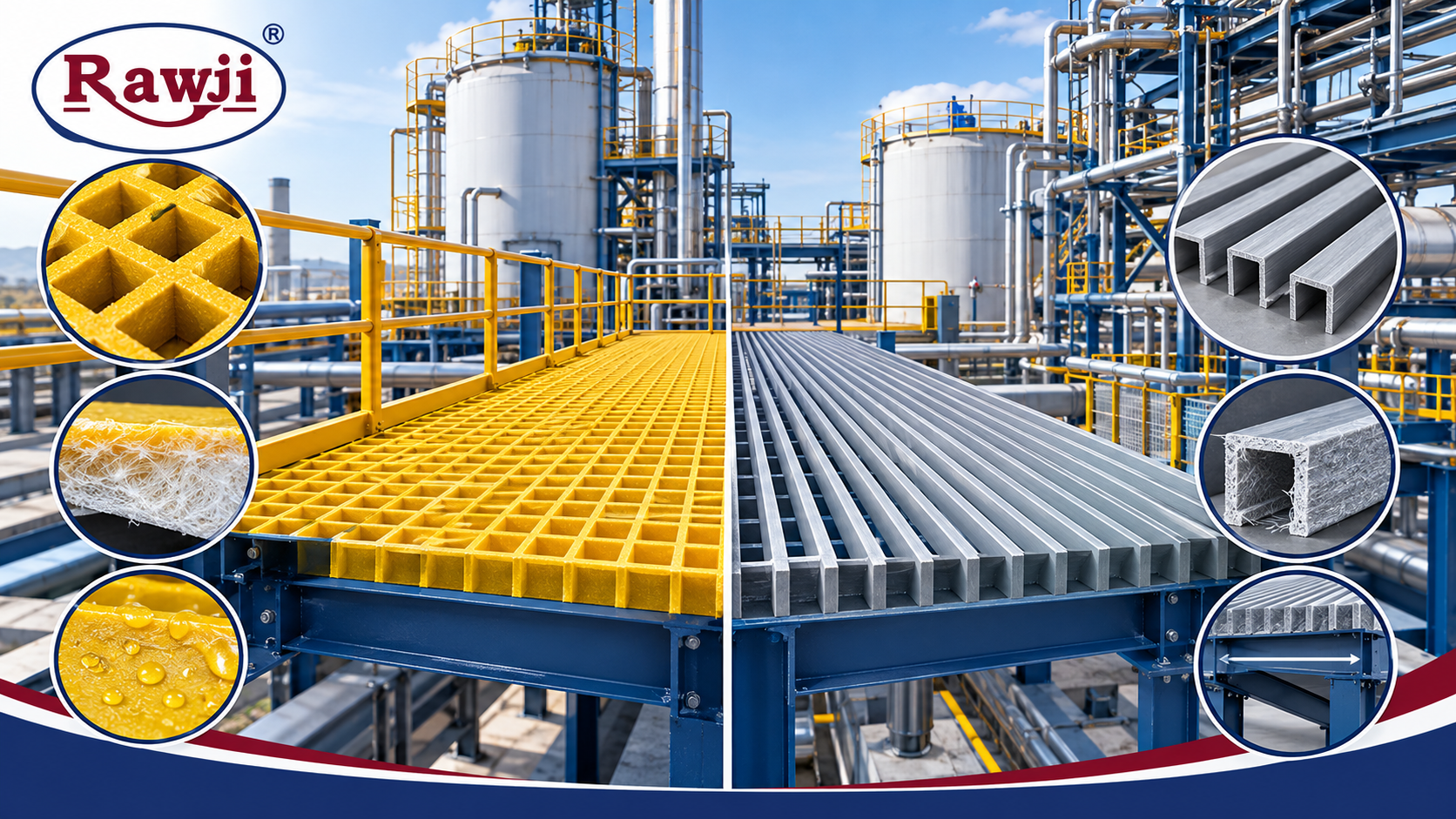
- Is the product molded or pultruded?
- What is the grating thickness?
- What is the recommended support span?
- What load can the grating support?
- What anti-slip surface is provided?
- Is test documentation available?
- What chemicals is the product designed to resist?
- Is UV stabilization available?
- What guardrail and support options are available?
- Can panels be cut to project dimensions?
- Can the supplier provide installation information?
- What quality documentation accompanies the order?
- Can the manufacturer provide repeatable specifications for future orders?
These questions help move the conversation from price per square metre to actual engineering suitability.
13. When FRP Walkways Make Sense
FRP walkways can be considered when a project requires a combination of:
- Corrosion resistance
- Slip-resistant access
- Low-maintenance surfaces
- Lightweight components
- Non-metallic construction
- Industrial access platforms
- Chemical-environment compatibility
Typical applications include chemical plants, wastewater facilities, refineries, power plants, manufacturing facilities and marine environments.
The important point is to design the complete walkway system around the application.
FRP Walkway Buyer Checklist
Before approving an FRP walkway or catwalk, confirm:
☐ Application identified
☐ Chemical exposure reviewed
☐ Temperature identified
☐ Indoor/outdoor use confirmed
☐ UV requirements checked
☐ Load requirements established
☐ Support span established
☐ Grating thickness selected
☐ Anti-slip surface specified
☐ Guardrails considered
☐ Toe boards considered
☐ Access stairs/gates reviewed
☐ Fall-protection requirements reviewed
☐ Technical datasheet obtained
☐ Relevant test documentation obtained
☐ Installation requirements confirmed
Conclusion
A safe industrial walkway is not created simply by choosing an FRP grating and calling it "OSHA compliant."
The better approach is to specify the grating, support structure, anti-slip surface, access system and fall protection as one complete walking-working system.
For general-industry applications in the United States, OSHA's 29 CFR 1910 Subpart D provides requirements covering walking-working surfaces and related fall-protection provisions.
For projects requiring FRP gratings, industrial walkways, platforms or corrosion-resistant access systems, Rawji Exports can discuss the required dimensions, loading, environment and application before product selection.
Need an FRP walkway or catwalk specification? Call Rawji Exports at +91 9920228162