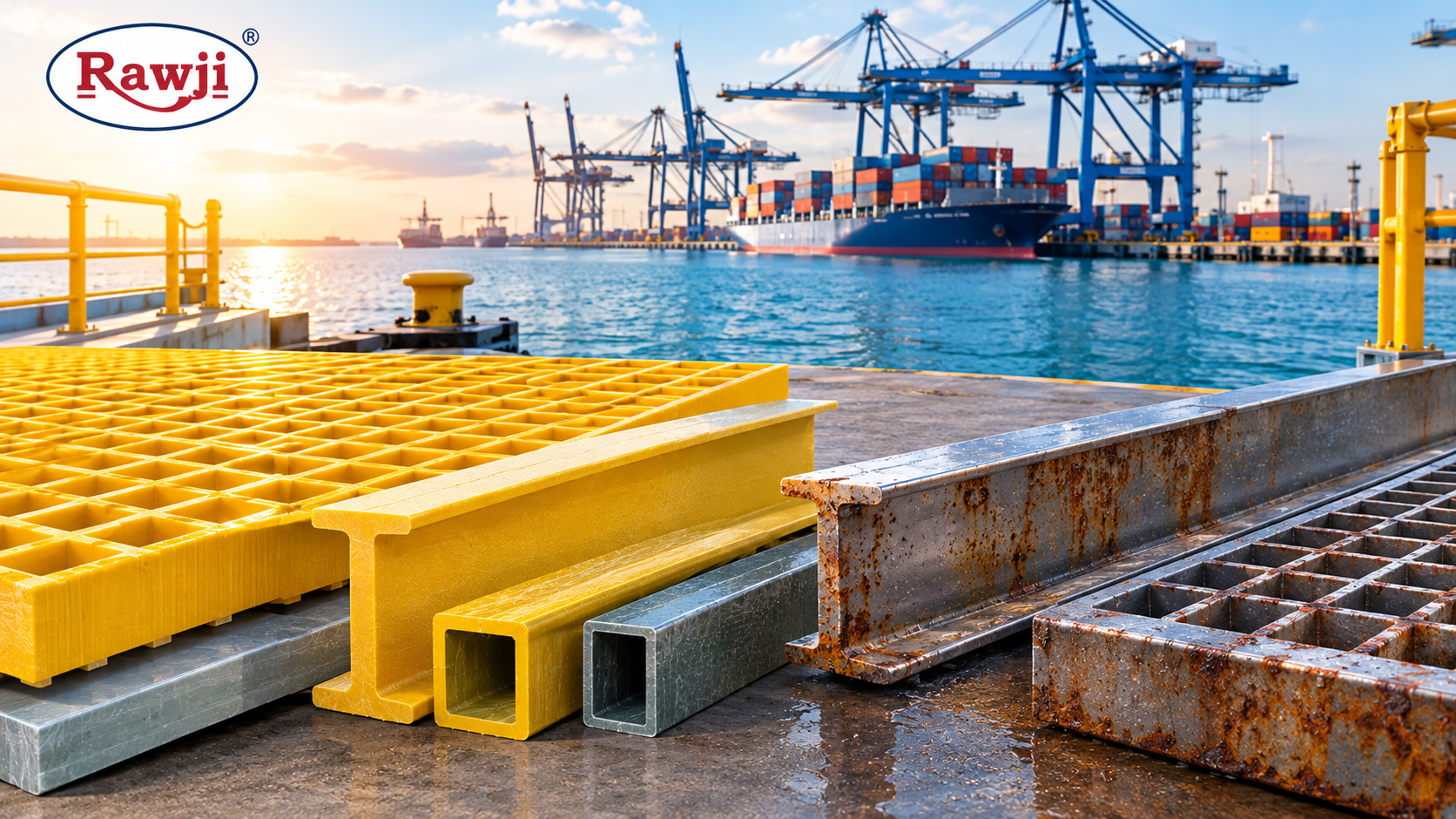
Marine and coastal environments are among the most demanding conditions for industrial materials. Salt-laden air, humidity, seawater exposure and repeated wet-dry cycles can accelerate corrosion in conventional metals and increase maintenance requirements.
This is why engineers and procurement teams often compare FRP vs SS316 when selecting materials for coastal platforms, walkways, ladders, structural supports and other industrial applications.
The right choice, however, depends on the environment, structural requirements, chemical exposure, temperature, loading and expected service conditions.
Why Is Marine and Coastal Corrosion a Problem?
Salt is particularly aggressive toward many metals. Chloride ions can contribute to localized corrosion, including pitting and crevice corrosion, when susceptible metals are exposed to marine conditions.
Stainless steel 316 is widely selected for improved resistance to chloride-containing environments because its composition includes molybdenum. However, SS316 is not completely immune to corrosion, particularly under severe or stagnant chloride exposure.
FRP, or Fibre Reinforced Plastic, takes a different approach. Instead of relying on a metallic surface to resist corrosion, FRP uses glass-fibre reinforcement embedded in a polymer resin matrix.
This makes properly specified FRP attractive for many marine and coastal industrial applications where corrosion resistance and low maintenance are priorities.
FRP vs SS316: Understanding the Difference
FRP and SS316 are not identical materials and should not be treated as direct substitutes in every engineering application.
FRP
FRP combines reinforcing fibres with a polymer resin. Depending on the resin system and manufacturing method, FRP can provide:
- High corrosion resistance
- Low weight
- Electrical non-conductivity
- Low maintenance requirements
- Good resistance to moisture
- Useful strength-to-weight performance
Pultruded FRP profiles can be manufactured in sections such as beams, channels, angles and tubes for structural and access-system applications.
SS316
SS316 is an austenitic stainless steel commonly selected where good corrosion resistance, strength and durability are required.
It can be suitable for marine hardware, fasteners, equipment and structural components, but performance depends on the exact environment, fabrication, geometry, exposure and maintenance conditions.
Therefore, the question should not simply be “Is FRP better than SS316?”
A better engineering question is:
“Which material provides the required performance for the specific marine environment and application?”
Where Can FRP Be Used in Marine Environments?
FRP is used across a range of industrial access and structural applications where corrosion can be a major concern.
These can include:
- Marine walkways
- Coastal industrial platforms
- Offshore access structures
- Chemical plant platforms near coastal areas
- Water and wastewater facilities
- Desalination facilities
- Pumping stations
- Port and harbour infrastructure
- Cable support structures
- Ladders and handrails
- Equipment access platforms
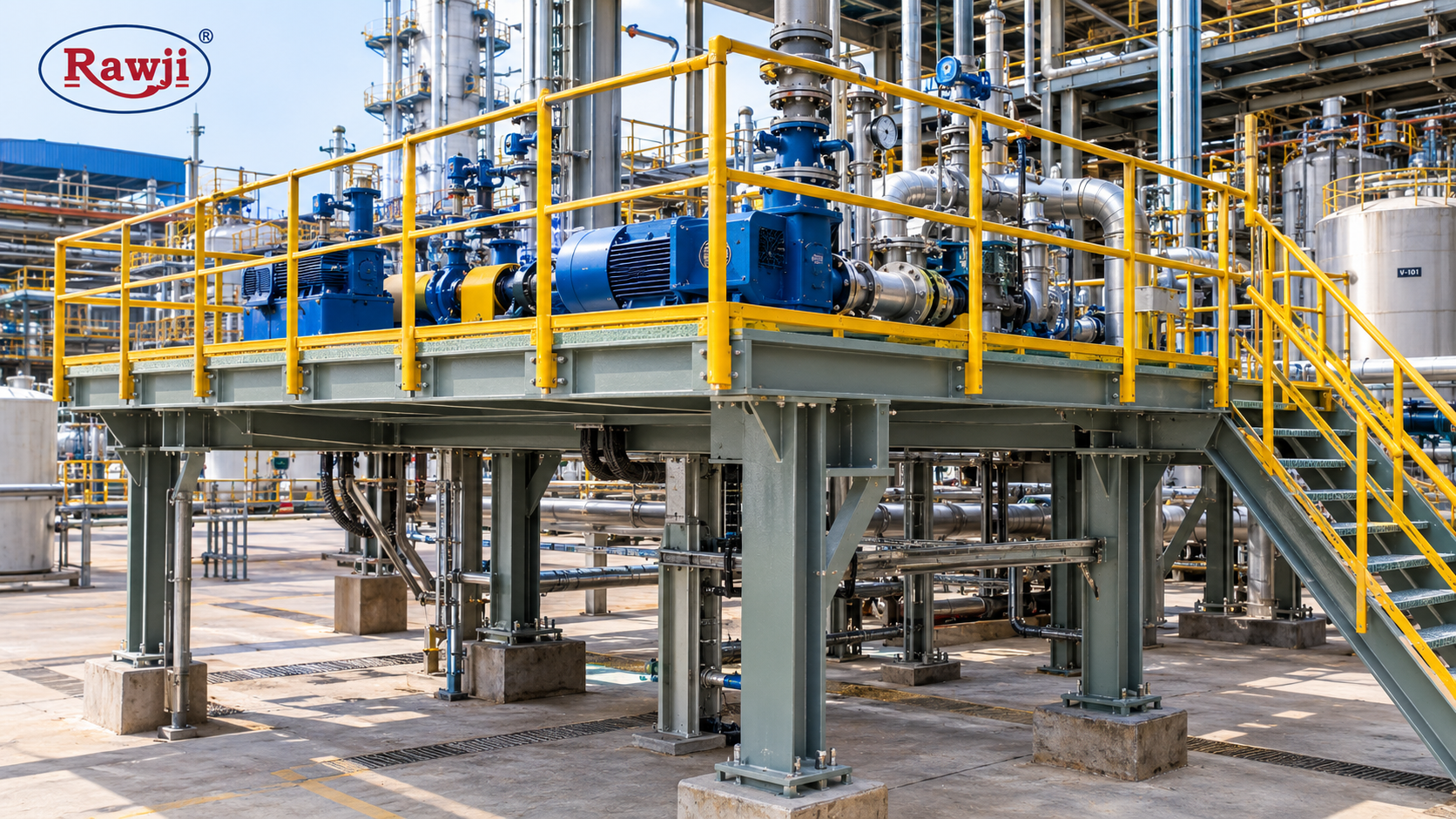
For example, a complete FRP access platform can combine FRP structural profiles with suitable grating, handrails and access components to create a lightweight corrosion-resistant system.
Why Consider FRP for Coastal Industrial Platforms?
One of the biggest advantages of FRP is its resistance to many corrosive environments.
For a coastal facility, this can be particularly useful where structures are continuously exposed to salty air, humidity and moisture.
FRP also has a relatively low weight compared with many metallic structural systems. This can simplify transportation, handling and installation, depending on the project design.
Another consideration is electrical conductivity. FRP is generally non-conductive, making it useful in applications where electrically conductive structural materials may create additional concerns.
However, FRP should always be selected according to the actual resin, fibre architecture, profile design and environmental exposure rather than assuming every FRP product has identical performance.

Not necessarily.
FRP and SS316 have different properties and are appropriate for different applications. SS316 may remain the preferred material where metallic strength, temperature resistance, mechanical properties or specific fabrication requirements are important.
FRP can become particularly attractive where corrosion resistance, low weight, electrical non-conductivity and reduced maintenance are important.
For some projects, a combination of materials may also be appropriate. For example, FRP can be used for platforms, walkways and structural components while stainless steel or other suitable materials are used for specific connection or equipment requirements.
What Should You Check Before Buying Marine FRP?
Buyers should look beyond the phrase “marine grade” and request application-specific technical information.
Important considerations include:
Resin System
The resin influences chemical and environmental resistance. Polyester, vinyl ester and other systems can have different performance characteristics.
Structural Loading
For platforms and walkways, profile dimensions and structural capacity should be selected according to the required span, loading and support arrangement.
UV Exposure
Outdoor coastal installations can experience significant sunlight exposure. UV resistance and the manufacturer's recommended surface protection should therefore be considered.
Saltwater Exposure
If the product will have direct or repeated seawater contact, the manufacturer should confirm suitability for the expected exposure conditions.
Connections and Fasteners
A corrosion-resistant FRP structure can still experience problems if unsuitable metallic fasteners or connection components are selected. The complete system should therefore be evaluated.
FRP for Marine and Coastal Infrastructure in India
India has a long coastline and many industrial facilities operate in coastal environments. Ports, marine infrastructure, chemical facilities, water-treatment plants, utilities and manufacturing sites can all face challenges associated with humidity and salt exposure.
For these applications, marine FRP products can provide an alternative approach to conventional metallic structures where corrosion resistance and lower structural weight are important.
Rawji Exports manufactures and supplies a range of FRP/GRP products for industrial applications, including structural profiles and grating systems that can be considered for corrosion-prone environments.
Buyers looking for FRP industrial platforms should evaluate the complete application—including structural profiles, grating, handrails, supports, connections and expected environmental exposure—rather than selecting individual components only on price.
Frequently Asked Questions
Is FRP more corrosion resistant than SS316?
FRP can provide excellent resistance to many corrosive environments and can be advantageous in saline conditions. SS316 also has strong corrosion resistance, but neither material should be considered universally corrosion-proof. The actual performance depends on the environment and material specification.
Is FRP suitable for marine applications?
Yes. Properly specified FRP can be used for marine and coastal walkways, platforms, ladders, handrails, structural supports and other industrial applications.
Why is FRP used near seawater?
FRP is attractive near seawater because of its corrosion resistance, low weight and non-conductive properties. The appropriate resin and product specification should be selected according to the exposure conditions.
Is SS316 completely resistant to saltwater?
No. SS316 offers improved chloride resistance compared with many stainless steel grades, but prolonged or severe chloride exposure can still cause localized corrosion under certain conditions.
Which is lighter, FRP or SS316?
FRP is generally much lighter than SS316, which can provide advantages in transportation, handling and installation for suitable applications.
Can FRP and SS316 be used together?
Yes. Hybrid systems can use FRP for platforms, walkways or structural components and stainless steel for selected fasteners, connections or equipment. Compatibility and the complete system design should be evaluated.
Final Verdict: FRP or SS316?
There is no single material that is best for every marine application.
SS316 remains a proven engineering material where metallic strength, fabrication characteristics and specific mechanical requirements are important.
FRP, on the other hand, can be a strong option for marine and coastal platforms, walkways and structural applications where corrosion resistance, lightweight construction, electrical non-conductivity and lower maintenance are priorities.
For a coastal project, the best decision comes from evaluating the environment, loading, exposure, resin system, structural design and lifecycle requirements together.
If you are evaluating FRP vs SS316 for a marine or coastal industrial project, discuss the application requirements with a qualified FRP manufacturer before finalising the material specification.