Fire Retardant Class 1 FRP Composites (ASTM E84 / BS 476): Safety Standards for Indian Industries
Fire performance is an important consideration when specifying composite materials for chemical plants, power facilities, industrial platforms, infrastructure projects and other demanding environments.
Fire-retardant FRP composites can combine the corrosion resistance and lightweight advantages of fibre-reinforced polymer with a formulation designed to reduce flame spread and improve fire-test performance.
However, terms such as ASTM E84 Class A, BS 476 Class 1, fire retardant and fire resistant should not be treated as interchangeable. They refer to different test methods or performance concepts.
Understanding the difference is important for engineers, EPC contractors, architects and procurement teams selecting FRP products for industrial projects.
What Are Fire-Retardant FRP Composites?
FRP stands for Fibre Reinforced Plastic. The material generally combines reinforcing fibres, such as glass fibre, with a polymer resin system.
The resin formulation can be modified using flame-retardant technologies to influence the material's behaviour when exposed to heat and flame.
Depending on the product and specification, fire-retardant FRP can be manufactured for applications such as:
- Industrial platforms
- Walkways
- Gratings
- Structural profiles
- Ladders
- Handrails
- Cable-management systems
- Access structures
- Industrial enclosures
The actual fire performance depends on the complete material formulation, manufacturing process, product geometry and test specimen.
Recent research on pultruded FRP also highlights the importance of standardised fire-performance testing and specification for structural FRP products.
What Does ASTM E84 Measure?
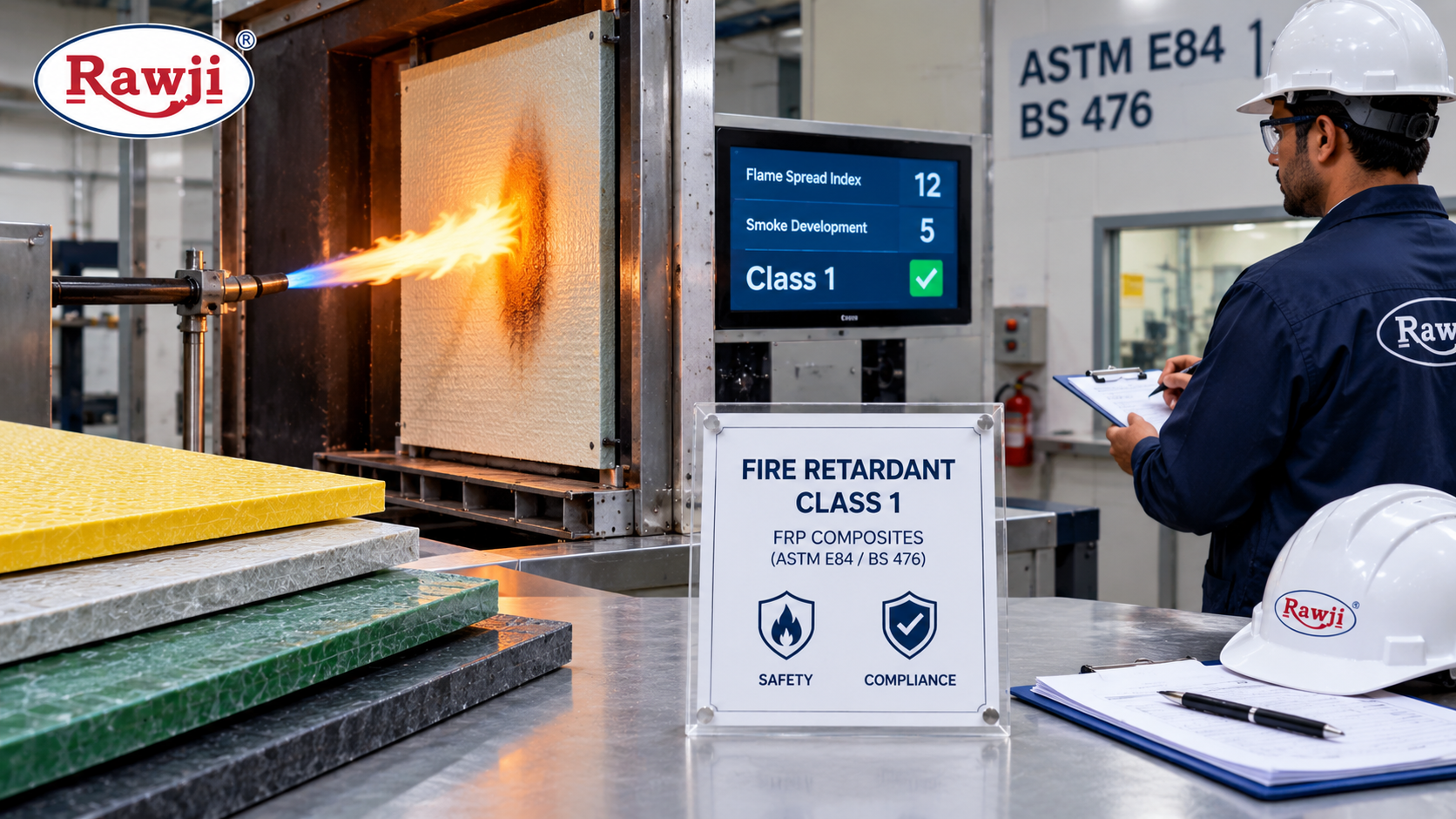
ASTM E84 is the Standard Test Method for Surface Burning Characteristics of Building Materials.
The test evaluates the relative surface-burning behaviour of a material under controlled laboratory conditions and reports measures including flame spread index (FSI) and smoke developed index (SDI). ASTM specifically states that these measurements are comparative and that the test does not, by itself, classify a material as non-combustible.
This distinction is important when evaluating ASTM E84 FRP composites.
A product described as having an ASTM E84 rating should therefore be evaluated against the exact test report, specimen configuration and project requirement.
What Is ASTM E84 Class A?
ASTM E84 classifications are commonly expressed as Class A, Class B and Class C based on flame-spread performance.
In many product specifications, ASTM E84 Class A is associated with a flame spread index of 25 or less, with smoke development also reported separately.
However, buyers should request the actual test report rather than relying only on a marketing statement such as “Class A.”
The current ASTM standard describes E84 as a controlled surface-burning test and makes clear that the result does not represent every aspect of fire hazard or fire risk in an actual installation.
What Is BS 476 Part 7 Class 1?
BS 476 Part 7 evaluates the surface spread of flame over the exposed surface of a product.
Its classification system includes Class 1, Class 2, Class 3 and Class 4, with Class 1 representing the highest classification within that particular surface-spread test.
Therefore, when a specification calls for BS 476 Class 1, the buyer should confirm that the product has actually been tested to the relevant BS 476 Part 7 methodology.
It should not automatically be assumed that a BS 476 Class 1 result and an ASTM E84 Class A result are identical certifications.

The table is a high-level comparison. Actual engineering performance depends on the grade, design, environment and product construction.
How Rawji Can Help With FRP Requirements
Rawji Exports provides FRP products for industrial and infrastructure applications.
Depending on the project, buyers can evaluate requirements for:
- FRP gratings
- FRP structural profiles
- Industrial FRP products
- FRP doors
- FRP security cabins
- Other composite solutions
For example, buyers looking for FRP structural profiles can evaluate profile geometry and application requirements before selecting the appropriate section.
For industrial flooring and access systems, FRP gratings can be considered where corrosion resistance and low-maintenance performance are important. FRP Gratings
Frequently Asked Questions
What is fire-retardant FRP?
Fire-retardant FRP is a fibre-reinforced polymer composite formulated to provide improved fire-related performance compared with a standard FRP formulation. The actual performance must be verified for the specific product and test method.
What does ASTM E84 test?
ASTM E84 evaluates surface-burning characteristics under controlled conditions and reports flame spread and smoke-developed indices. It is not, by itself, a complete fire-risk assessment.
What is ASTM E84 Class A?
ASTM E84 Class A is a commonly used classification associated with low flame-spread performance. Buyers should verify the actual FSI/SDI values and test report for the specific product.
What is BS 476 Class 1?
BS 476 Part 7 Class 1 is a surface-spread-of-flame classification. The product must be evaluated according to the applicable BS 476 test requirements.
Is ASTM E84 Class A the same as BS 476 Class 1?
No. They come from different test methods and classification systems. A project requiring one standard should not automatically accept the other without confirming equivalence with the responsible engineer, consultant or applicable specification.
Is fire-retardant FRP fireproof?
No. “Fire retardant” and “fireproof” should not be treated as interchangeable terms. FRP fire performance is product-specific and should be verified using the required test standard and test evidence.
Can FRP gratings be fire retardant?
Yes, fire-retardant FRP grating products can be manufactured and tested for specified fire-performance requirements. The exact rating depends on the product formulation, construction and test result.
Can fire-retardant FRP be used in chemical plants?
It can be suitable for certain chemical-plant applications when its corrosion resistance, structural performance and fire characteristics are appropriate for the specific environment.
Conclusion
Fire-retardant FRP composites can provide an interesting combination of lightweight construction, corrosion resistance and controlled fire-performance characteristics for industrial applications.
But the most important point for engineers and procurement teams is to look beyond the phrase “fire retardant.”
The correct selection should consider the exact product, resin system, thickness, application, environmental exposure, applicable fire standard and verified test report.
ASTM E84 and BS 476 Part 7 should also be treated as distinct standards rather than interchangeable labels.
For an Indian industrial project requiring FRP gratings, structural profiles, platforms or other composite components, discuss the project specification with the manufacturer before finalising the material.
Need a project-specific FRP specification or quotation? Contact Rawji Exports