Molded vs Pultruded FRP Gratings: Which One Should You Choose?
If you are specifying flooring for a chemical plant, wastewater treatment facility, refinery or industrial platform, you will eventually come across two common FRP grating options:
Molded FRP grating and pultruded FRP grating.
At first glance, they can look almost identical.
Both can provide corrosion resistance. Both can be supplied with anti-slip surfaces. Both can be used for walkways, platforms, stairs and access areas.
So why are there two different constructions?
The answer is in how the grating is manufactured and how it is expected to carry load.
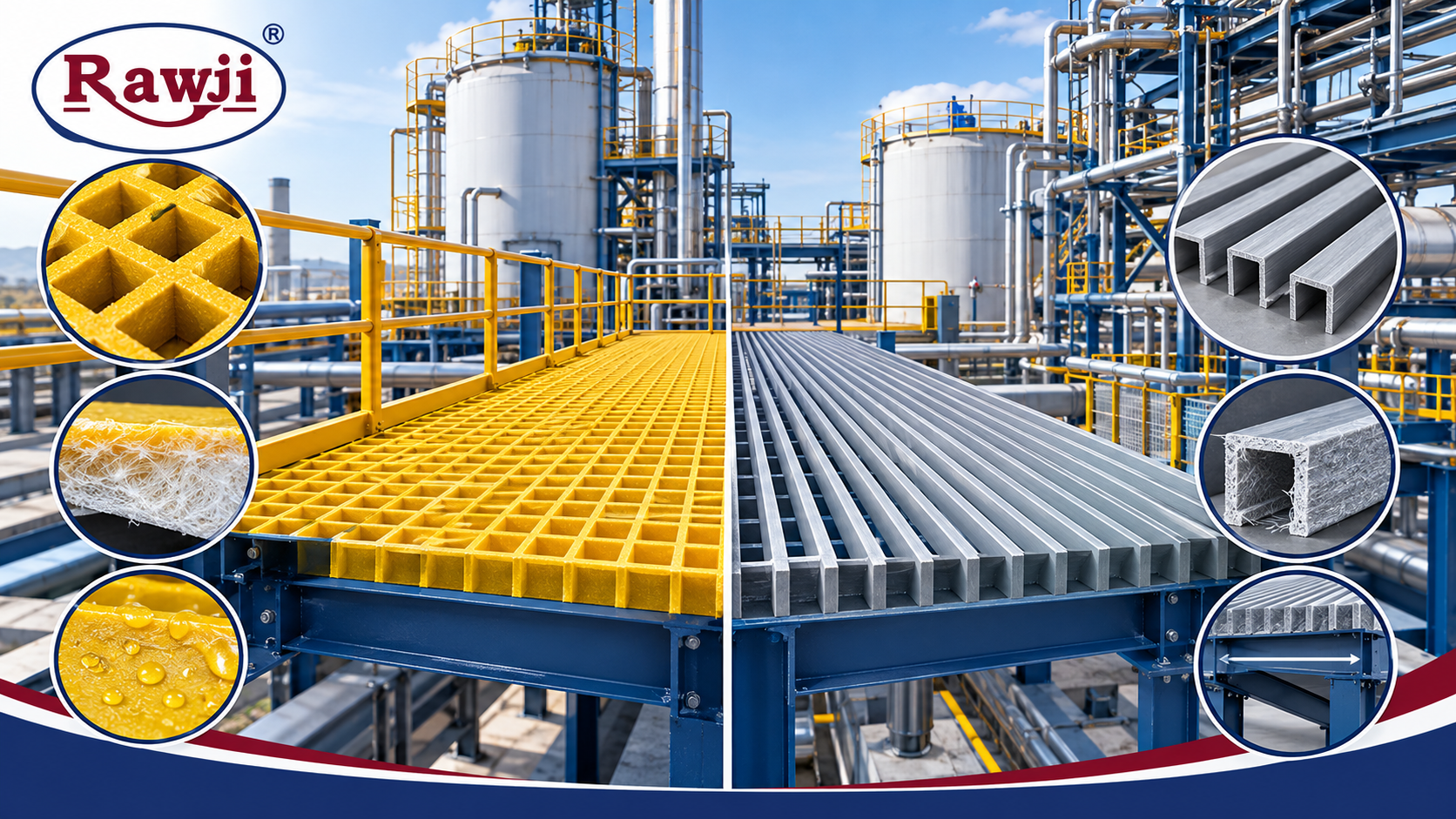
Molded grating is formed as an integrated panel, while pultruded grating uses continuous fiberglass-reinforced bearing bars and cross rods assembled into panels. This difference affects the way each type handles load, span and certain application requirements.
If you're buying FRP grating for a real project, here's how to think about the decision.
First: Don't Choose the Grating by Appearance
This is where many purchasing decisions start going wrong.
A buyer sees two yellow FRP panels and asks:
"Which one is cheaper per square metre?"
But the more useful questions are:
- What is the support span?
- What load will the panel carry?
- Is traffic pedestrian or equipment-related?
- Is the environment chemically aggressive?
- Will the surface become wet or oily?
- Is the panel being used as flooring, a stair tread or a platform?
- Does the project require a particular resin system?
- What technical documentation is available?
The price comparison only becomes meaningful after the technical specification is matched.
Molded FRP Grating: The Construction Explained
Molded FRP grating is manufactured as an integrated panel, with resin and fiberglass reinforcement forming the grating structure.
One practical characteristic is its bi-directional load capability, which can make it useful where loads may not always be concentrated along one predictable direction. Industry technical references describe molded grating as a one-piece construction with bidirectional strength and options for slip-resistant surfaces.
This makes molded grating worth considering for applications such as:
- Chemical plant walkways
- Wastewater treatment platforms
- Industrial flooring
- Drainage areas
- Equipment platforms
- Stair treads
- Maintenance access areas
The actual suitability still depends on thickness, span, loading and resin selection.
Pultruded FRP Grating: Why the Design Is Different
Pultruded grating uses continuous fiberglass reinforcement in the bearing bars.
That construction produces a grating with a stronger directional load path, which is one reason pultruded systems are often considered for longer spans and applications with higher structural demands.
Imagine a long industrial walkway where the grating needs to bridge between supports.
Instead of asking only:
"How thick is the grating?"
the engineer needs to consider:
"How far does it need to span, and in which direction is the primary load carried?"
That's where pultruded construction can become particularly relevant.
The Real Decision: Span and Loading
This is probably the most useful way to approach molded vs pultruded FRP grating.
Suppose you have a maintenance walkway above a wastewater tank.
The grating is supported every 500 mm.
That's a very different structural situation from a platform where supports are much farther apart.
The same product thickness does not automatically produce the same performance across different spans.
So when requesting a quotation from an FRP grating manufacturer in India, provide:
1. Clear opening
2. Support spacing
3. Expected load
4. Panel dimensions
5. Walking direction
6. Application environment
7. Required surface finish
Without these details, a supplier is being asked to price a product without knowing the actual engineering requirement.
Where Molded Grating Can Make Practical Sense
Molded grating is often considered when the project needs a combination of:
- Corrosion resistance
- Multi-directional load capability
- Open drainage
- Slip-resistant surface
- Easy fabrication
- Industrial durability
For example, imagine a chemical plant walkway surrounding a process tank.
There may be water, chemical residue and maintenance activity.
The walkway doesn't simply need to carry people.
It needs to remain usable in an environment where conventional steel may require significant corrosion protection and maintenance.
FRP molded grating can therefore be considered as part of the access-platform design.
Where Pultruded Grating Can Make Practical Sense
Pultruded grating becomes particularly interesting when the design calls for:
- Longer spans
- Directional load carrying
- Higher stiffness
- Structural platform applications
- Walkways with predictable support orientation
A good example would be an elevated service walkway where the grating spans between relatively widely spaced structural supports.
The bearing bars can be oriented in the primary load direction.
This is why simply saying "FRP grating is FRP grating" isn't enough.
The manufacturing architecture matters.
Now Let's Talk About Resin
The fiberglass reinforcement provides the structural framework.
But the resin system matters enormously when the grating is exposed to chemicals.
A chemical plant does not simply have "corrosion."
It may have:
- Acids
- Alkalis
- Solvents
- Chlorinated chemicals
- Salts
- Process liquids
- Cleaning chemicals
- High-temperature fluids
Different resin systems have different chemical-resistance characteristics.
Published FRP technical data shows that resin selection can significantly affect suitability for particular chemical environments, concentrations and temperatures.
So don't tell your supplier:
"I need chemical-resistant FRP."
Give them the actual environment.
For example:
Chemical: Sulfuric acid
Concentration: Project-specific
Temperature: Project-specific
Exposure: Continuous/intermittent
The manufacturer can then evaluate the appropriate material system.
Vinyl Ester vs Polyester: Why Buyers Ask
You will often hear vinyl ester resin mentioned for aggressive chemical applications.
That's because vinyl ester systems are widely used in FRP applications where corrosion resistance is important.
Published industrial case studies, for example, document vinyl-ester molded grating being selected for corrosive chemical-processing environments.
But that doesn't mean:
"Vinyl ester = suitable for every chemical."
It doesn't.
The correct resin depends on the chemical, concentration, temperature and exposure conditions.
That distinction is important when writing a project specification.
The Surface Is Not a Cosmetic Detail
Now consider a walkway inside a wastewater plant.
It rains.
Water reaches the platform.
Workers walk across it wearing safety footwear.
The surface becomes contaminated with process residue.
This is where the top surface of the grating becomes an engineering consideration.
FRP gratings can be supplied with abrasive or grit-type slip-resistant surfaces.
When selecting one, ask:
What surface finish is being supplied?
What operating environment is it designed for?
Is test information available?
Don't settle for the word "anti-slip" without understanding the actual product specification.
FRP Grating in Chemical Plants
Chemical manufacturing is one of the applications where material selection becomes particularly important.
A walkway around a process area may be exposed to chemicals while also being used for routine inspection and maintenance.
The engineering team may need:
- Corrosion resistance
- Slip resistance
- Load capacity
- Structural stability
- Low-maintenance flooring
- Safe access around equipment
FRP systems are used in chemical-processing environments specifically because appropriately selected composite systems can address corrosion-related requirements.
But the resin, grating construction and installation still need to match the actual plant environment.
FRP Gratings in Wastewater Treatment
Wastewater facilities create another challenging environment.
Walkways can surround:
- Clarifiers
- Tanks
- Pumps
- Filters
- Aeration systems
- Chemical dosing equipment
- Treatment channels
There can be constant moisture, chemical exposure and outdoor weather.
In these areas, buyers often look for a combination of:
Corrosion resistance + drainage + slip resistance + low maintenance.
That makes FRP grating an option worth evaluating.
The correct product should still be selected based on the chemical environment and structural requirements.
What About Heavy-Duty FRP Gratings?
"Heavy duty" is one of the most overused phrases in industrial product marketing.
If a supplier says:
Heavy-duty FRP grating
ask:
Heavy-duty for what load and what span?
A proper specification should identify the intended loading and support conditions.
For example:
- Pedestrian traffic
- Maintenance trolley
- Equipment
- Forklift
- Concentrated load
- Platform equipment
The same phrase can otherwise mean very different things to different suppliers.
What About OSHA?
This is another area where buyers need to be precise.
OSHA's General Industry Walking-Working Surfaces requirements are contained in 29 CFR 1910 Subpart D. They cover walking-working surfaces and fall-protection requirements. OSHA also requires employers to protect workers from applicable fall hazards.
So an FRP grating should not simply be marketed as:
"OSHA compliant."
The complete installed walkway needs to be considered.
That includes factors such as:
- Walking surface
- Structural support
- Openings
- Guardrails
- Access
- Fall hazards
- Maintenance
- Installation
For a project specifically governed by OSHA, the engineering and safety team should verify the complete installation against the applicable OSHA requirements.
A Common Procurement Mistake: Choosing by Thickness Alone
A buyer may say:
"Give me 38 mm FRP grating."
But thickness alone doesn't tell the complete story.
Two gratings with similar thickness can have different:
- Bearing-bar dimensions
- Resin systems
- Reinforcement
- Mesh configurations
- Support requirements
- Load capabilities
- Surface finishes
That's why a professional RFQ should contain the application and design conditions, not just a thickness number.
What Should You Put in Your RFQ?
If you're sending an enquiry to an FRP grating manufacturer, this is a much better starting point:
Application: Chemical plant walkway
Panel size: Project-specific
Clear span: 1000 mm
Expected loading: Project-specific
Surface: Anti-slip
Environment: Chemical exposure
Chemical: [Name]
Concentration: [Value]
Temperature: [Value]
Installation: Outdoor
Required quantity: [Value]
Now the manufacturer has enough information to discuss the appropriate construction.
Molded or Pultruded? Ask These 7 Questions
Before choosing either type, ask:
1. What is my actual support span?
Longer spans may change the appropriate grating construction.
2. What load will the grating carry?
Don't rely on "heavy duty."
3. Is the load directional?
This can influence whether a pultruded construction is appropriate.
4. What chemicals are present?
Give the supplier actual chemicals and concentrations.
5. Will the surface be wet?
If yes, specify the required slip-resistant finish.
6. Is the installation indoors or outdoors?
UV and weather exposure may affect material selection.
7. What documentation do I need?
Ask for:
- Technical datasheet
- Load information
- Resin information
- Chemical-resistance data
- Relevant test reports
- Installation/fabrication information
Technical resources from FRP manufacturers commonly provide load charts, chemical-resistance data and design guidance for molded and pultruded systems.
The Simple Way to Think About It
Don't think:
Molded = good
Pultruded = better
Think:
Application → Load → Span → Environment → Resin → Surface → Installation
That sequence leads to a much better product specification.
Molded and pultruded gratings are not simply two competing versions of the same product. Their construction gives them different characteristics, so the right selection depends on the engineering requirements.
Where Rawji Exports Can Help
For a project requiring FRP gratings, the useful conversation should start with the application.
Tell the supplier:
- Where will the grating be installed?
- What is the support span?
- What load will it carry?
- Is it exposed to chemicals?
- Is an anti-slip surface required?
- Is it indoors or outdoors?
- What quantity is required?
Rawji Exports can discuss these requirements for industrial applications involving FRP walkways, platforms, chemical plants, wastewater facilities and other areas where composite grating is being considered.
You can explore the FRP Gratings range, learn about Rawji's services, or contact Rawji Exports for a project-specific requirement.
For direct enquiries: +91 9920228162.
Final Buyer Checklist
Before approving your FRP grating purchase:
☐ Application identified
☐ Support span measured
☐ Design load established
☐ Panel dimensions confirmed
☐ Molded/pultruded construction discussed
☐ Resin system identified
☐ Chemical exposure reviewed
☐ Temperature considered
☐ Anti-slip surface specified
☐ Indoor/outdoor installation confirmed
☐ UV requirement considered
☐ Technical datasheet requested
☐ Load information requested
☐ Chemical-resistance information requested
☐ Installation details confirmed
This is the information that turns an FRP grating purchase from a simple price comparison into a proper engineering specification.