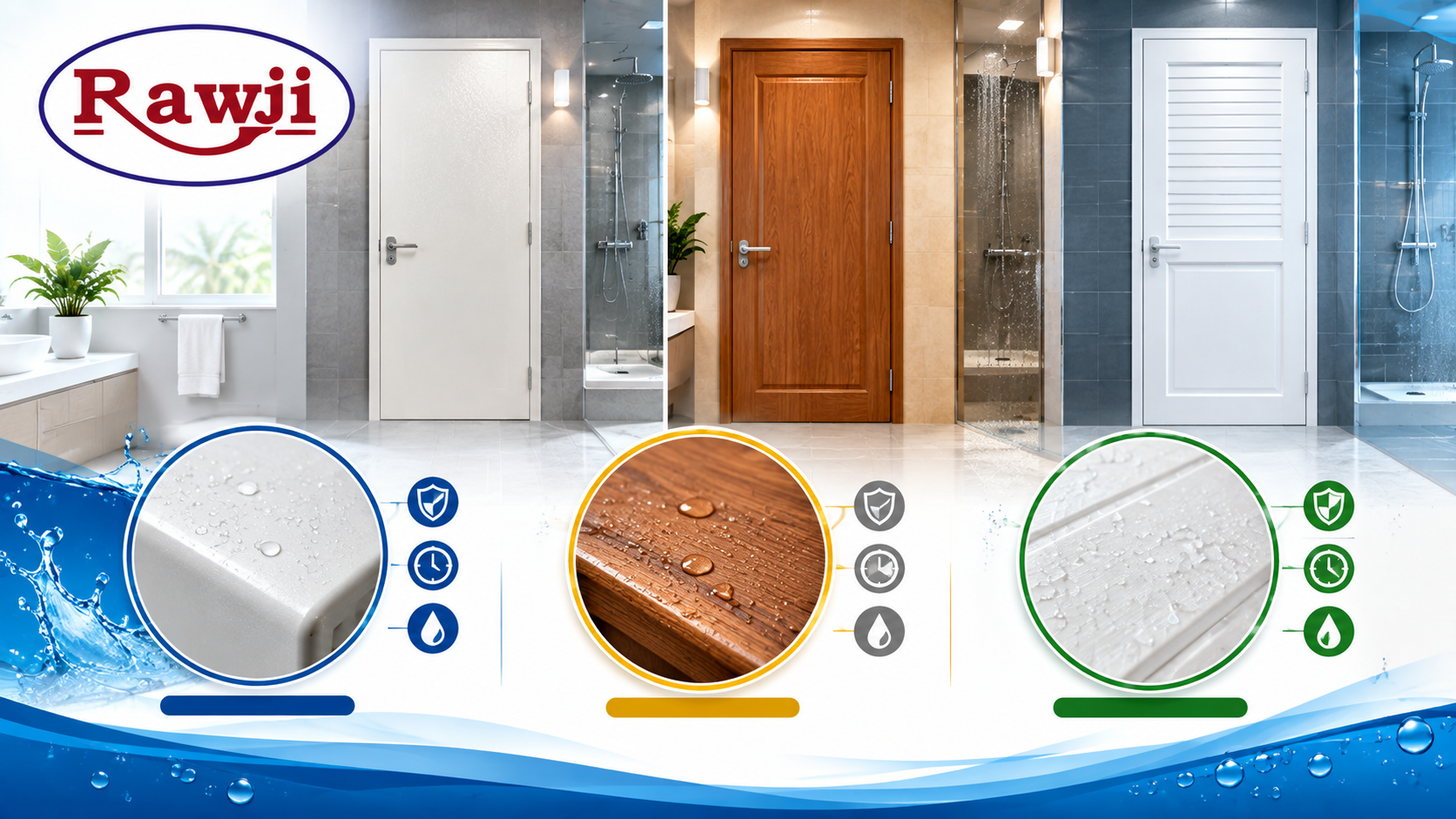
FRP vs Wooden vs PVC Doors for Bathrooms & Wet Areas
Bathrooms, washrooms, utility areas and other wet spaces are harder on doors than they may appear.
The door may be exposed to water splashes, steam, humidity, cleaning chemicals and repeated opening and closing every day. In coastal areas or industrial facilities, the surrounding environment can be even more demanding.
This is why choosing a door for a wet area should not be based only on appearance or initial price.
The important questions are:
Will the door absorb moisture? Will the edges swell? Can it handle regular cleaning? Will the frame deteriorate? How much maintenance will it require?
FRP, wood and PVC can all be used in different applications, but they behave differently when exposed to moisture.
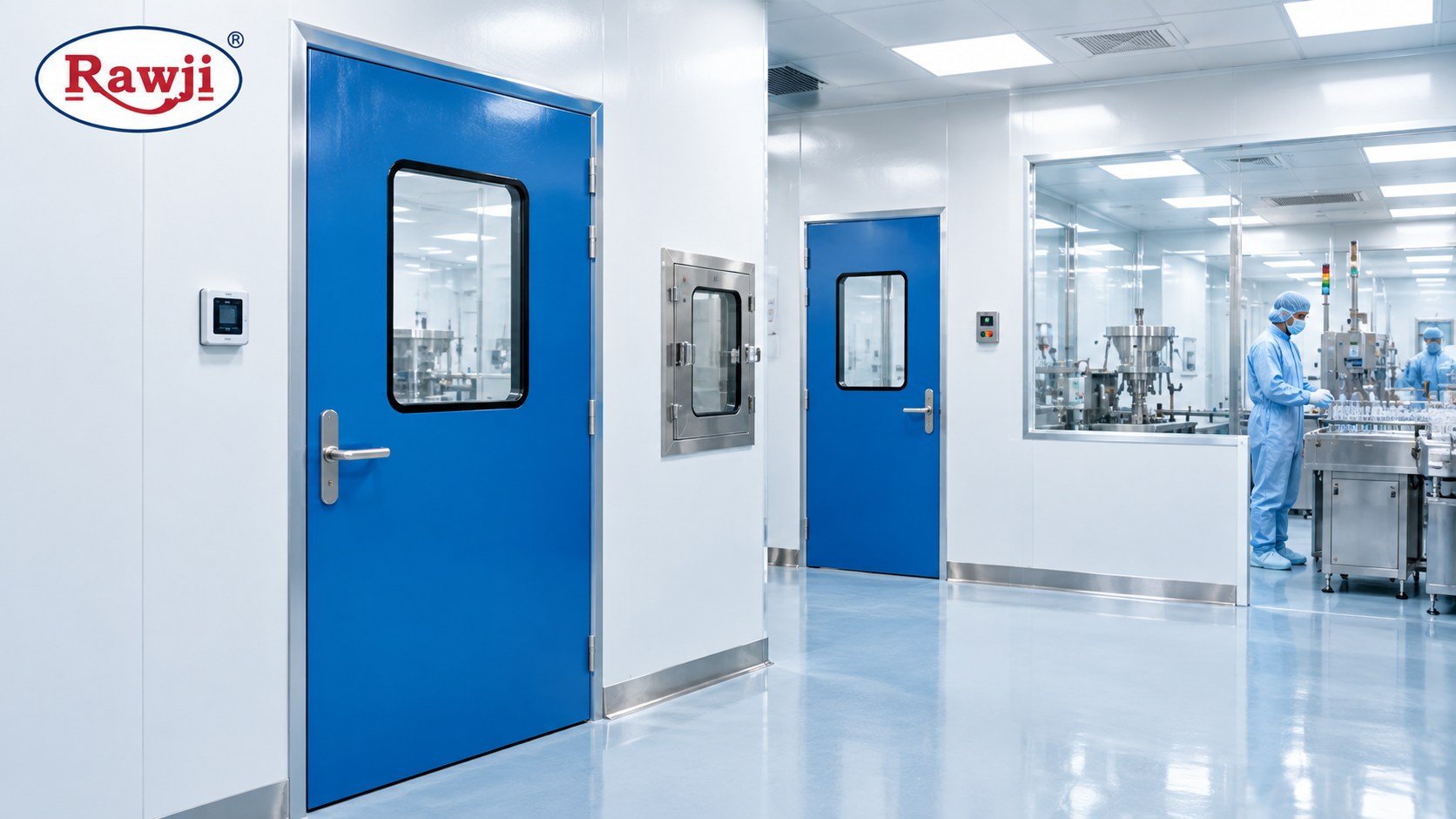
For many commercial and industrial applications, FRP doors are considered because of their resistance to moisture, corrosion and everyday wear.
Here's what buyers should know before choosing a door for a bathroom or other wet area.
1. Why Wet Areas Are Different
A normal interior room may provide a relatively dry environment for a door.
A bathroom doesn't.
A door in a wet area can experience:
- Water splashes
- High humidity
- Steam
- Frequent washing
- Cleaning chemicals
- Wet floors
- Temperature changes
- Continuous daily use
The problem isn't necessarily the first few months.
A door may look perfectly fine when installed but develop problems later if moisture repeatedly enters vulnerable areas.
The door leaf, edges, frame, hardware and fixing points all need to be considered.
2. How Wooden Doors Behave in Wet Areas
Wood can provide an attractive and familiar appearance, which is why wooden doors are still common in residential and commercial interiors.
However, moisture is one of the main concerns when using conventional wood-based doors in wet environments.
Repeated exposure to moisture can contribute to:
- Swelling
- Warping
- Peeling finishes
- Edge deterioration
- Rot under suitable conditions
- Paint or laminate damage
- Hardware problems
The vulnerability often becomes more noticeable around the bottom edge of the door.
Think about what happens in a bathroom:
The floor gets wet.
The bottom of the door is close to that floor.
The door is opened and closed repeatedly.
If moisture enters an unprotected edge or joint, deterioration can eventually begin.
That doesn't mean every wooden door will fail in a bathroom. Properly engineered, sealed and maintained wood products can perform in appropriate applications.
But buyers need to understand the maintenance requirements and moisture limitations of the particular door construction.
3. What Makes FRP Different?
FRP stands for Fibre Reinforced Plastic.
Instead of relying on conventional wood construction, FRP doors use a composite material system consisting of a polymer matrix reinforced with fibres.
This construction can provide useful characteristics for wet and demanding environments.
Depending on the specific product, FRP doors can offer:
- Moisture resistance
- Corrosion resistance
- Easy-clean surfaces
- Low water absorption
- Resistance to many common environmental conditions
- Durable construction
- Customizable dimensions and finishes
This is one reason FRP bathroom doors are used in applications where moisture exposure is a regular part of the operating environment.
The important word is application-specific.
Not every FRP door has identical construction or chemical resistance, so buyers should still ask the manufacturer for the relevant product specification.
4. What About PVC Doors?
PVC doors are another common option for bathrooms and other wet areas.
One of their advantages is that PVC-based materials do not behave like untreated wood when exposed to water.
They can therefore be suitable for certain residential and light-duty applications.
However, buyers should look beyond the word "waterproof."
The overall performance depends on:
- Door construction
- Thickness
- Internal structure
- Hardware
- Frame
- Hinges
- Surface quality
- Installation
A door can have a water-resistant outer surface while other components of the assembly remain vulnerable.
This is particularly important for commercial buildings where doors may be opened hundreds of times every day.
5. FRP Doors for High-Moisture Commercial Areas
A residential bathroom and a commercial washroom do not necessarily experience the same level of use.
Commercial washrooms can involve:
- High foot traffic
- Frequent cleaning
- Repeated water exposure
- Cleaning chemicals
- Continuous door operation
- Higher maintenance expectations
Hospitals, schools, factories, hotels, malls and commercial buildings may therefore require a more durable door specification.
This is where commercial FRP doors can be considered.
The advantage is not simply that the door is "waterproof."
The complete door assembly can be specified for the environment in which it will operate.
6. FRP Doors Are Useful Beyond Bathrooms
The same moisture-resistant characteristics that make FRP useful for bathrooms can be valuable in many other locations.
For example:
Industrial washrooms
Factories may have washrooms and utility areas exposed to frequent washing.
Chemical facilities
Doors may be exposed to moisture and chemical vapours.
Food-processing areas
Frequent cleaning can place additional demands on door surfaces.
Pharmaceutical facilities
Hygiene and easy-clean surfaces can become important considerations.
Hospitals
Doors may need to withstand frequent cleaning and regular use.
Coastal buildings
Humidity and saline environments can create additional corrosion concerns for conventional materials and hardware.
Utility rooms
Water, cleaning and maintenance activities can create demanding conditions.
7. Don't Forget the Door Frame
One of the easiest mistakes is to evaluate only the door leaf.
Imagine installing a highly moisture-resistant door but pairing it with a frame that deteriorates quickly in the same environment.
The result is still a vulnerable door system.
When buying FRP doors in India, ask about:
- Door leaf
- Frame
- Hinges
- Lock
- Handle
- Fasteners
- Seals
- Installation method
The complete assembly should match the environment.
For particularly demanding applications, ask the manufacturer whether the frame and hardware are also appropriate for the moisture or chemical exposure.
8. What Makes a Good FRP Bathroom Door?
A suitable FRP bathroom door should be designed around its intended use.
Important specifications can include:
Door thickness
Thicker construction may be appropriate for applications requiring additional rigidity.
Frame profile
The frame should be compatible with the door and installation opening.
Hardware
Hinges, handles and locks should be suitable for the environment.
Surface finish
The surface should be easy to clean and appropriate for the intended application.
Water resistance
Ask what type of water exposure the product is designed for.
Chemical resistance
If strong cleaning agents are used, confirm material compatibility.
Dimensions
Commercial projects often require non-standard door sizes.
Colour and finish
FRP doors can be supplied in different finishes depending on the product and project requirements.
9. FRP Is Not Just for Small Bathroom Doors
A common misconception is that FRP doors are mainly intended for residential bathrooms.
In reality, composite doors can be specified for much larger industrial and commercial applications.
Examples include:
- Industrial FRP doors
- Utility-room doors
- Plant-room doors
- Chemical-area doors
- Washroom doors
- Hospital doors
- Commercial building doors
- Warehouse doors
- Food-processing doors
For industrial applications, buyers should focus on the actual exposure conditions and performance requirements rather than simply selecting a standard bathroom door.
10. What About Corrosion?
In wet areas, the surrounding environment can be just as important as the water itself.
For example, an industrial washroom or chemical facility may have:
- Cleaning chemicals
- Acidic or alkaline substances
- Saline moisture
- Chemical vapours
- High humidity
This is where corrosion resistant FRP doors can become useful.
FRP itself does not rust in the same way as conventional ferrous metals.
However, the door assembly may contain metal components.
Therefore, if corrosion is a serious concern, ask about the complete hardware and frame specification, not just the FRP panel.
11. Cleaning and Hygiene Matter
Wet-area doors are often cleaned much more frequently than ordinary interior doors.
A surface that is difficult to clean can become a maintenance problem.
For hospitals, commercial washrooms, factories and food-related facilities, buyers should consider:
- Smooth surface finish
- Easy cleaning
- Resistance to routine cleaning chemicals
- Minimal dirt-trapping areas
- Edge construction
- Hardware design
This is particularly relevant when the door is part of a hygiene-sensitive environment.
12. When Should You Consider FRP Instead of Wood?
FRP becomes particularly interesting when moisture is a regular operating condition rather than an occasional accident.
Consider an FRP door when the application involves:
- Frequent water exposure
- High humidity
- Regular washing
- Industrial cleaning
- Chemical exposure
- Coastal humidity
- Heavy commercial use
- Low-maintenance requirements
Wood can still make sense when aesthetics, architectural requirements and environmental conditions favour it.
The decision should therefore be based on where the door will be installed and how it will be used.
13. When Does PVC Make Sense?
PVC can be practical for applications where:
- Water exposure is frequent
- The environment is relatively light-duty
- Budget is important
- The application is residential or low-traffic
- A simple easy-clean door is required
But commercial and industrial buyers should verify the construction before making a decision.
Ask:
What is inside the door?
How thick is it?
What hardware is being used?
How is the frame constructed?
What happens if the door is repeatedly slammed or heavily used?
Those questions reveal much more than the material name alone.
14. What Should Buyers Ask an FRP Door Manufacturer?
Before ordering, ask the supplier:
- What is the door construction?
- What is the door thickness?
- What material is used for the frame?
- What hardware is included?
- Is the door suitable for continuous moisture exposure?
- Is chemical resistance information available?
- What cleaning chemicals can be used?
- Can the door be customized?
- Are different finishes available?
- What sizes are available?
- Can the manufacturer provide installation instructions?
- What warranty is provided?
- Is the same specification available for repeat orders?
These questions help turn a simple price enquiry into a proper product specification.
15. Customized FRP Doors for Commercial Projects
Not every building has standard openings.
A project may require:
- Customized height
- Customized width
- Special frame dimensions
- Different hardware
- Special colours
- Vision panels
- Different opening directions
- Special locking arrangements
This is where working directly with an FRP door manufacturer in India can be useful.
Instead of modifying a standard product after purchase, the requirements can be discussed before manufacturing.
For large projects, buyers should provide drawings or opening dimensions whenever possible.
16. What About FRP Doors Price in India?
There isn't one fixed FRP doors price in India because the final cost depends on the specification.
Pricing can change based on:
- Door size
- Thickness
- Core construction
- Frame
- Hardware
- Finish
- Quantity
- Customization
- Delivery location
- Installation requirements
A basic bathroom door and a heavy-duty industrial FRP door should not be expected to have the same price.
When requesting quotations, provide the complete specification so suppliers can quote the same product configuration.
That makes price comparison much more meaningful.
17. A Simple Buyer Checklist
Before purchasing a door for a bathroom or wet area, check:
☐ Expected moisture exposure
☐ Door dimensions
☐ Door thickness
☐ Frame material
☐ Hardware material
☐ Cleaning requirements
☐ Chemical exposure
☐ Frequency of use
☐ Surface finish
☐ Required colour/appearance
☐ Fire requirements, if applicable
☐ Installation method
☐ Warranty
☐ Manufacturer's technical specification
This checklist can prevent the common mistake of choosing a door based only on appearance and price.
So, Which Door Should You Choose?
There is no single material that is automatically correct for every bathroom or wet-area application.
The right choice depends on the environment.
If the area is relatively dry and appearance is the primary consideration, conventional wood may be suitable.
If the requirement is a simple water-resistant door for a light-duty application, PVC may be appropriate.
If the environment involves regular moisture, washing, humidity, corrosion concerns or demanding commercial/industrial use, FRP becomes a material worth evaluating.
The important thing is to compare the complete door system, not just the material name.
Final Thoughts
A bathroom door may look like a small part of a building, but selecting the wrong material can create recurring maintenance problems.
Wood can require careful protection against moisture. PVC can be practical in suitable applications but should be evaluated based on its actual construction and intended duty. FRP can provide a durable composite option where moisture, cleaning and corrosion resistance are important considerations.
For commercial and industrial projects, the best starting point is simple:
Tell the manufacturer where the door will be installed, what it will be exposed to and how frequently it will be used.
That allows the door construction, frame and hardware to be specified around the actual application.
For FRP bathroom doors, industrial FRP doors, customized FRP doors and corrosion-resistant door solutions, Rawji Exports can help buyers evaluate the appropriate specification.
For product enquiries, call Rawji Exports at +91 9920228162.