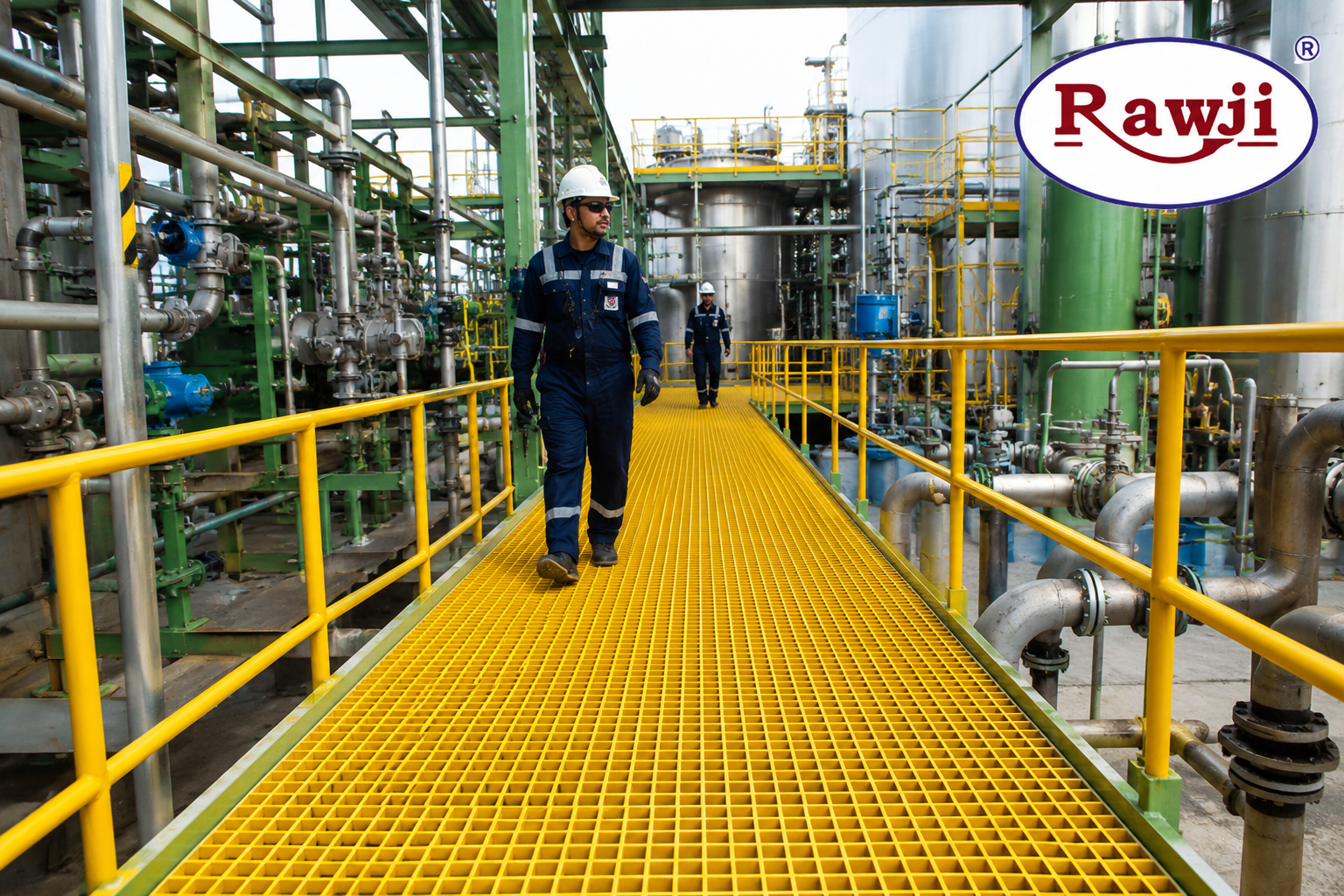

In aggressive chemical manufacturing, wastewater treatment, and offshore environments, industrial flooring must resist continuous acid exposure and heavy pedestrian traffic. FRP Gratings have replaced corroding steel walkways, offering superior chemical resistance, non-conductivity, and OSHA-compliant anti-slip surfaces.
Authored by Rawji Exports (kumar), this guide details the engineering differences between Molded and Pultruded FRP gratings, resin matrix selection, and span deflection criteria.
1. Molded vs Pultruded Architecture
| Parameter | Molded FRP Gratings | Pultruded FRP Gratings |
|---|---|---|
| Load Direction | Bidirectional (Square Mesh) - equal strength in both directions. | Unidirectional - high strength along load-bearing I-bars. |
| Resin Content | 65% - 70% (Maximum chemical resistance). | 30% - 35% (Maximum tensile modulus & long spans). |
| On-Site Cutouts | Effortless circular and angled pipe cutouts without edge framing. | Requires auxiliary support framing when bearing bars are severed. |
| Optimal Span | 300 mm to 900 mm. | 900 mm to 1800 mm without mid-span deflection. |
2. Resin Selection for Chemical Plants
- Isophthalic Polyester (ISO): For moderate acids, alkalis, and wastewater treatment plants.
- Vinyl Ester (VE): For concentrated fuming hydrochloric acid (HCl 37%), sulfuric acid (H₂SO₄ up to 70%), and caustic soda (NaOH 50%).
- Phenolic: For offshore oil rigs and underground transit tunnels requiring zero smoke emission (ASTM E84 Class 1).
Get Custom Molded & Pultruded FRP Grating Sizing
Speak with Rawji Exports' technical composite engineering team for load-deflection calculations.
Get Grating Quotation